Welcome to our website

Some good ideas from The Daily Green. We'll run a couple a day:Have you started to think about positive changes for next year? Please send us your ideas as we work together in 2013 for a better, healthier world:Avoid Waste: RecycleCost: $0For every trash can of waste you put outside for the trash collector, about 70 trash cans of waste are used in order to create that trash. To reduce the amount of waste you produce, buy products in returnable and recyclable containers and recycle as much as you can..

Showing posts with label Economic development. Show all posts

Friday, July 27, 2012

Expansion set for Menomonee Valley solar panel factory

From a blog post by Tom Content on JSOnline:

Helios Solar Works has received a loan of $652,079 to support its $11 million investment to purchase equipment and add a third shift of workers at its Menomonee Valley solar panel factory.

The loan was announced by the Northwest Side Community Development Corp., based on funds from the U.S. Department of Health and Human Services.

Helios opened its factory at 1207 W. Canal St. last year. The funds will be used to help meet demand from new orders from Helios customers in the United States, Asia and Europe, according to the community development corporation. The corporation said the loan will support the addition of up to 40 jobs.

“It is very satisfying to know that the NWSCDC is helping Helios ship solar panels to customers worldwide stamped ‘Made in Milwaukee,’ " said Sam McGovern-Rowen, NWSCDC planning director, in a statement. Helios makes efficient panels using a highly automated production process.

Helios chief executive Steve Ostrenga says employment currently stands at about 35, running two shifts, and the company is planning its capital investment in part to accommodate a third shift and development of a new panel aimed at the residential market.

“We’ve been doing primarily commercial and this gets into the residential space with a differentiated product that lowers the total cost of installation,” he said in an interview.

Tuesday, July 17, 2012

Business group asks senator to end "unsubstantiated attacks on wind"

From a news release issued by the Wisconsin Energy Business Association:

Wisconsin Businesses Call on Sen. Lasee to End His War on Wind 
Unsubstantiated attacks on wind industry are preventing economic growth across Wisconsin 

In another attempt to hinder wind development and economic growth in Wisconsin, state Senator Frank Lasee (R-De Pere) is demanding that the Public Service Commission of Wisconsin revisit the state’s uniform wind siting rule, PSC 128—a rule that is the product of years of work by the Commission, a citizen advisory council, and industry experts. His most recent attacks are based on the demonstrably false claim that wind energy facilities cause adverse health impacts.

“Senator Lasee’s ongoing hostility towards Wisconsin’s wind industry is preventing real economic growth,” said Chris Kunkle of the Wisconsin Energy Business Association. “National companies looking to invest in Wisconsin’s economy see these unwarranted and baseless attacks and continue to stay out of Wisconsin.”

Medical professionals are unwavering in their repeated analysis that there is no discernible correlation between wind energy generation and negative health impacts. This was stated most recently in a report to the Massachusetts Dept. of Public Health that definitively concluded there is “no foundation for a set of symptoms that is called Wind Turbine Syndrome” and was also recently affirmed by Wisconsin’s Department of Health Services (DHS). . . .

Thursday, December 8, 2011

Coal Critic Coming to Madison to Speak on Effective Renewable Energy Advocacy, January 13, 2012

For immediate release
December 7, 2011

More information
Michael Vickerman
608.255.4044
mvickerman@renewwisconsin.org

Leslie Glustrom, research director of Colorado-based Clean Energy Action, and an unwavering critic of utility reliance on coal for electricity generation, will be the featured speaker at RENEW Wisconsin’s Energy Policy Summit.

The Summit will be held on Friday, January 13, 2012, at the University of Wisconsin-Extension’s Pyle Center located on the UW-Madison campus. Summit attendees will spend the day discussing and selecting renewable energy strategies that make sense in the current political environment in Wisconsin. More information on the Summit can be found on the RENEW Wisconsin website at http://www.renewwisconsin.org.

As research director, Glustrom authored in 2009 an extensively referenced report on U.S. coal supplies titled, “Coal—Cheap and Abundant—Or Is It? Why Americans Should Stop Assuming that the US has a 200-Year Supply of Coal,” available for free at http://www.cleanenergyaction.org.

Since 2009, Glustrom has traveled to numerous states helping them to understand the likely constraints on their coal supplies.
Glustrom’s on-going research illuminates a future in which coal prices will likely continue to escalate, driven by a combination of less accessible coal supplies, increasing demand from Asian countries, and rising diesel fuel costs for hauling coal to distant markets like Wisconsin.

Clean Energy Action is spearheading a campaign to shut down Colorado’s coal-fired power plants and replace them with locally generated renewable electricity.

“Leslie’s experiences with Clean Energy Action can help Wisconsin renewable energy advocates formulate effective strategies for 2012 and beyond,” said Michael Vickerman, executive director of RENEW Wisconsin, a statewide sustainable energy advocacy organization headquartered in Madison.

“Even though Colorado is a coal-producing state, it has adopted some of the most aggressive policies in the country for advancing renewable energy,” said Vickerman. “Colorado’s commitment to clean energy is driving its economy at a time when its coal output is diminishing. For example, Vestas, the world’s largest manufacturer of wind turbines with four plants employing 1,700 people in Colorado, supplied 90 turbines this year to Wisconsin’s largest wind project, the Glacier Hills Wind Park in Columbia County.”

“Leslie will inspire us to reverse the retreat from renewables and retake the initiative going forward,” Vickerman said.


In Boulder, Glustrom was part of the team that led the successful 2010 and 2011 ballot initiatives allowing Boulder to move ahead with plans to municipalize and break away from the long term commitment to coal plants made by their incumbent utility, Xcel Energy.

-- END --

Monday, December 5, 2011

Local firms join energy efficiency effort backed by Obama, Clinton

From an article in the Milwaukee Journal Sentinel:

Washington - President Barack Obama is enlisting former President Bill Clinton and companies including Briggs & Stratton Corp., Kohl's Corp., 3M and Alcoa Inc. in a $4 billion initiative to cut energy costs in buildings and encourage hiring for construction jobs.

The program, which the administration forecast would create tens of thousands of jobs, is expected to provide work for energy service contracting firms including Johnson Controls Inc. and Trane.

It combines $2 billion in energy-efficiency upgrades over two years for federal buildings along with commitments from companies, cities and universities to put $2 billion into similar efforts.

The improvements to government buildings will be made under an existing federal program that uses private financing, according to the administration. The goal: boost buildings' energy efficiency by at least 20% by 2020.

"This is good business" that will help create jobs and promote energy independence, Clinton said after he and Obama toured a building in Washington that is being retrofitted. "It's the nearest thing we've got to a free lunch in a tough economy."

Obama is expanding the "Better Building Initiative" he announced in February and joining it with a White House effort to spark hiring that was begun after the president's $447 billion jobs plan stalled in Congress.

Johnson Controls is among 17 contractors, including Honeywell International, Trane and Ameresco, that are active contractors in a government program that pays for energy-saving projects through the savings the government sees over time on its energy bills.

Friday's announcement is a sizable boost for a program that Johnson Controls has worked on since it launched in 1998, said Clay Nesler, Johnson Controls vice president.

Wednesday, October 26, 2011

State urged to beef up clean energy policies to create jobs

From an article by Judy Newman in the Wisconsin State Journal:

Two reports show Wisconsin has a significant renewable power industry, but with a stronger state commitment, it could be saving more energy and creating more jobs.

Wisconsin has more than 300 businesses involved in wind or solar energy, providing more than 12,000 jobs, according to a study by the Environmental Law and Policy Center in Chicago.

It found 171 Wisconsin companies that either produce, sell or install wind power equipment or plan wind development.

Another 135 companies are part of the solar energy industry. For example, Cardinal Glass makes solar panels in Mazomanie; Helios recently opened a solar panel factory in Milwaukee.

"These are real jobs; these are real businesses. Many are existing businesses that are branching out into new product lines," said Howard Learner, the center's executive director.

Ten years ago, Wisconsin was considered a leader on renewal energy policy, so companies located here, Learner said. "That policy support has now been eroding, and neighboring states —Minnesota, Illinois and Michigan — now have much stronger renewable standards than Wisconsin does and are exceeding Wisconsin in terms of jobs," he added.

Meanwhile, at a news conference Tuesday, representatives of clean energy businesses made a pitch for more money for Wisconsin's Focus on Energy program, saying it will save energy, cut consumers' costs and create jobs.

In the 10 years since it was created, Focus programs have saved utility customers 6.8 billion kilowatt-hours of electricity, or 6.8 months of the total residential power use in the state, says the report by the Midwest Energy Efficiency Alliance in Chicago. It says the programs also have saved 278 therms of natural gas, or 1.8 years of statewide residential consumption.

Tuesday, October 25, 2011

Wind power amendment shot down

From an article by Mike Ivey in The Capital Times:

An effort to push forward with new rules for siting wind towers in Wisconsin has failed.

On a largely party-line 60-30 vote, the Republican-controlled Assembly on Thursday voted down an amendment that would have cleared the way for an expansion of wind generated electricity here.

The rules for siting of wind turbines were approved by the state Public Service Commission under former Gov. Jim Doyle. But implementation of those rules has been suspended under a directive from Gov. Scott Walker.

Walker and others, including Rep. Frank Lasee, R-Ledgeview,have said the rules should be reviewed again, with more consideration given to those living near wind farms. Some residents have complained of noise and visual impacts from wind turbines, which can be up to 300 feet tall.

Rep. Gary Hebl, D-Sun Prairie, had co-sponsored the wind amendment that was attached to a bill that allowed for larger trucks on Wisconsin highways, including trucks that carry equipment for electric transmission lines.

In a statement, Hebl said it was ironic that the wind amendment was shot down just as new figures showed Wisconsin lost more jobs in September.

Wednesday, October 19, 2011

No excuse to stall rules on wind farms

From an editorial in the Racine Journal Times:

The wind turbines have stopped turning in Wisconsin, figuratively speaking. For months, the rewrite of rules governing the siting of wind energy farms has been stalled. New investments and new jobs also have been stalled because of that, and there is no good reason for it.

When Gov. Scott Walker took office in January he worked to short-circuit the rule-making process which was then almost complete after two years. The Public Service Commission had reached a compromise with interest groups which would have placed the wind turbine towers about 450 feet away from the nearest property line but no less than 1,250 feet from the nearest residence. Walker wanted the property line setback increased to 1,800 feet.

Ultimately, a legislative committee didn’t act on a bill containing Walker’s proposed standard and instead ordered the PSC to start over. That’s where the process remains. A member of the agency told the Wisconsin State Journal that talks have made no progress and are stuck over the same old issues: noise, setback distance and effect on the value of neighboring properties.

If there is no progress by March the PSC’s original regulations will take effect anyway, but wind farm opponents have no incentive to negotiate. All they have to do is wait. Either wind energy proponents capitulate and give them what they want, or the Legislature writes a new law which gives them what they want or Walker, with his new power to review regulations first, will give them what they want.

There is a high price for this stalling. Since the rules were becalmed, five major wind energy projects have been suspended or canceled. Those would have infused about $1.6 billion in economic development and created about 1,000 temporary full-time jobs. By contrast, the proposed northern Wisconsin iron mine which the Legislature is looking to accommodate is supposed to bring a $1.5 billion investment and 700 jobs.

Friday, September 23, 2011

Germantown company erects 100 ft Wisconsin-built wind turbine


From an article on ControlDesign.com:

It was like the Egyptian obelisk going up in “The 10 Commandments,” only it was a lot faster, and the slaves were replaced by portable hydraulics. Oh, and there was a 32 ft diameter fan at the top.

This was the scene on a sunny, early-September afternoon as Wago installed a 100 ft tall wind turbine next to its U.S. headquarters in Germantown, Wis. And, as if the gleaming white tower wasn’t impressive enough, it was “tipped up” in an amazing 8-10 minutes by a portable hydraulic unit hooked up right next to the tower. After that, it took only another 15 minutes to bolt down the tower, hook up its electronics, and get it spinning in the breeze of Wisconsin’s famous “dairy air.”

Capable of generating 20 kW for Wago’s multi-function facility, the small-scale, commercial-grade VP-20 turbine was built by Renewegy in nearby Oshkosh, Wis. The turbine employs Wago’s 787 Series power supplies, 756 Series cables/connectors, 288 Series fuse blocks and backup capacitor module.

The wind turbine’s initial cost was $80,000, but state and federal incentives allow Wago to reduce its bill by about $35,000. Other VP-20s have been installed at SCA Tissue in Neenah, Wis., and at the North Texas Job Corp Center in McKinney, Texas. Renewegy reports that it can install single 20 kW units on farms, 40 kW dual units to serve schools, and 100 kW five-unit systems for small wind farms and commercial applications.

Wednesday, July 20, 2011

Trains unnecessarily cost Wisconsin taxpayers millions due to Walker's fund rejection

From an article by Larry Sandler and Jason Stein:

Wisconsin taxpayers could wind up paying more to keep existing passenger train service from Milwaukee to Chicago than they would have paid to run new high-speed rail service from Milwaukee to Madison, according to a Journal Sentinel analysis of state figures.

The Legislature's budget committee voted 12-2 Tuesday to spend $31.6 million in mostly borrowed state money on Amtrak's Milwaukee-to-Chicago Hiawatha line, costs that could have been paid largely by an $810 million federal grant that would have extended the Hiawatha to Madison.

But Tuesday's vote doesn't cover all the spending that will be needed to keep running the Hiawatha, a growing service that carried nearly 800,000 passengers last year.

State transportation officials have estimated they would need millions more for locomotives, signals and a new maintenance base, even without expanding service beyond the current seven daily round trips.

And, like the spending approved Tuesday, all or most of those new costs would have been covered by the federal grant spurned by Gov. Scott Walker last year. That's because the Milwaukee-to-Madison service would have operated as an extension of the Hiawatha, as part of a larger plan to connect Chicago to the Twin Cities and other Midwestern destinations with fast, frequent trains.

Taken together, state taxpayers' share of the Hiawatha capital costs that would have been covered by the federal grant could total as much as $99 million, significantly more than the $30 million they would have paid for 20 years of operating costs on the Milwaukee-to-Madison segment, as estimated by former Democratic Gov. Jim Doyle's administration.

Walker had cited those operating costs as his main reason for opposing the 110-mph extension. Federal money would have paid all of its capital costs. And that doesn't count the other potential benefits that high-speed rail supporters have cited from the Milwaukee-to-Madison line, such as jobs, economic development, expanded tax base and improved freight rail tracks.

Monday, July 18, 2011

National Study Vindicates Wisconsin’s Clean Energy Policies

Immediate release
July 18, 2011

More information
Michael Vickerman
Executive Director
608.255.4044
mvickerman@renewwisconsin.org

National Study Vindicates Wisconsin’s Clean Energy Policies

Nearly a decade of forward-looking strategies propelled investments in Wisconsin’s clean jobs economy above other Midwest states, according to an economic study issued by The Brookings Institution, a nonpartisan public policy organization in Washington, D.C.

Reviewing data gathered between 2003 and 2010, the Brookings analysis pegged the number of clean economy jobs in the state at 76,858, a net increase of nearly 4,000. Measured as a percentage, Wisconsin’s clean economy accounted for 2.7% of all jobs in the state, compared with 2.5% for Iowa, 2.1% for Minnesota, 1.9 % for both Indiana and Michigan, and 1.8% for Illinois. Overall, Wisconsin ranked 8th among all states and the District of Columbia in the relative size of its clean economy.

The report categorizes clean economy jobs as those in energy efficiency and renewable energy; sustainable forestry products; recycling and reuse; waste management and treatment; organic food and farming; energy efficient appliance and building manufacturing; and more.

“Clearly, Wisconsin’s commitment to clean energy has paid dividends, attracting new businesses and creating high-paying jobs that could have easily gone elsewhere,” said Michael Vickerman, executive director of RENEW Wisconsin, a statewide organization advocating for public policies and private initiatives that advance renewable energy.

These policies and initiatives include the establishment of Focus on Energy, the region’s first ratepayer-funded energy efficiency and renewable energy program, attractive buyback rates offered by utilities for renewable energy, and innovative incentives to encourage customer installation of renewables.

In addition, Wisconsin’s adoption of a 10% renewable energy standard back in 2006 spurred new utility-scale installations built by skilled tradesmen employed by local contractors. During the study period, the number of wind-related jobs in Wisconsin doubled from less than 450 to 900.

As documented in the Brookings report, the wages for these clean economy jobs run higher than the statewide average ($37,931 vs. $35,906).

“Unfortunately, Wisconsin’s clean economy is in danger of losing a good deal of its steam as a result of policy rollbacks and funding cutbacks in the renewable energy arena,” Vickerman said. “The short-sighted attacks we’ve seen in 2011 could throw the state’s clean economy into reverse next year.”

So far this year, the Legislature has reduced funding for Focus on Energy, suspended the statewide rule regulating the permitting of wind turbines, and weakened the state’s renewable energy standard by allowing utilities to count Canadian hydropower toward their requirements.

“On top of that, We Energies, the state’s largest utility, announced that it will discontinue what had been an effective renewable energy initiative,” Vickerman said. “Among other accomplishments, it was instrumental in enabling Helios USA to build a solar-electric manufacturing facility in Milwaukee’s Menomonee River Valley.” The plant now employs 50 workers.

END

RENEW Wisconsin is an independent, nonprofit 501(c)(3) organization that acts as a catalyst to advance a sustainable energy future through public policy and private sector initiatives. More information on RENEW’s Web site at www.renewwisconsin.org.

Monday, July 11, 2011

Wisconsin’s Widening War on Renewable Energy

Dramatic Slowdown in Market Activity Anticipated
By Michael Vickerman
July 11, 2011

What started out as an opening salvo from the Walker Administration to shackle large-scale wind projects has in six months turned into a systematic campaign to dismantle the state policies that support renewable energy development. Joining the executive and legislative branches in pursuing policy rollbacks and/or funding cutbacks against renewables are various utilities and, surprisingly, Focus on Energy, Wisconsin’s ratepayer-funded energy efficiency and renewable programs.

Since January 1st, Wisconsin has seen a series of assaults against utility-scale projects and smaller renewable systems serving both residences and businesses. These include the following actions:
  • The Legislature suspended PSC 128, the statewide rule developed by the Public Service Commission last year in response to a law passed by the Legislature in 2009 ordering the agency to establish uniform standards for permitting wind energy systems. Since the March 1 suspension vote, wind development in Wisconsin has slowed to a standstill.
  • The Legislature adopted SB 81, a bill that RENEW Wisconsin describes as the “Outsource Renewable Energy to Canada Act.” SB 81 allows Wisconsin utilities to meet their renewable energy requirements beginning in 2015 with electricity generated from large hydropower plants in other states and Canada. By allowing Wisconsin utilities to become even more dependent on energy imports than they are today, SB 81 turns Wisconsin’s Renewable Energy Standard on its head. Importing large-scale hydropower exports the very dollars that could have been used to harness Wisconsin’s renewable energy resources. 
  • We Energies, the state’s largest electric utility, abruptly decided in May to walk away from an agreement with RENEW to dedicate $60 million over a 10-year period in support of renewable energy development in its territory. The decision came in the sixth year of this program. We Energies plans to reallocate the unspent dollars (totaling about $27 million) to general operations. 
  • Green Bay-based Wisconsin Public Service (WPS) instituted in April a new net energy policy designed to discourage new customer-sited renewable energy systems. Until recently WPS had been paying its customers the full retail rate for electricity that flows back on the wires, which is now about 12 cents/kWh. But under the new rate, WPS only pays three cents/kWh for electricity exported to the grid. Moreover, the utility calculates the net each month, which penalizes customers whose loads vary significantly depending on seasonal factors. Right now, the new policy only covers systems installed after March 2011, but WPS has said that it plans to apply that rate to older systems effective January 2013.
  • In its deliberations on the biennial state budget passed in June, the Legislature appended a rider to tie Focus on Energy’s annual budget to a percentage (1.2% of gross utility revenues). This action will mean a cut of $20 million in the program’s 2012 budget relative to this year’s allocation of $120 million. The Focus on Energy program provides grants and cash-back awards supporting customer investments in solar electric, solar thermal systems, small wind, biogas and biomass energy systems. 
  • Last, but certainly not least, as of July 1, Focus on Energy stopped accepting applications for business program incentives to help customers install renewable energy systems. These incentives, which average about $7 million per year, had been available since 2002 to businesses, farms, schools, local governments and other nonprofit customers. It is not clear when these incentives will be resumed and in what quantity. 
This one-two punch of policy rollbacks and funding cutbacks has cast a pall over the state’s renewable energy marketplace. At this year’s Energy Fair in Custer, Wisconsin, the prevailing mood of contractors and exhibitors was one of bewilderment tinged with anger. It is dawning on these companies that their state, which once took pride in its efforts to nurture a thriving renewable energy market, is becoming an inhospitable place to do business. The transformation is occurring with stunning speed; no business is likely to be spared from this abrupt reversal of fortune, which will hit home soon and continue for several months, if not years.

At this moment, however, the Wisconsin renewable energy landscape is humming with installation activity. New wind turbines are soaring above cornfields in Columbia County, where construction crews and operating engineers from Appleton-based Boldt Construction and Brownsville-based Michels Wind Energy assemble what will become Wisconsin’s largest wind generation facility. The towers for the Glacier Hills wind energy project are being fabricated at Tower Tech in Manitowoc. Solar hot water systems now crown the rooftops of new apartment and university buildings, while solar PV panels mounted on 14-foot-tall poles rise above a farm field in Dane County to power Epic Systems’ ground source heat pump system. A cranberry company in Monroe County is about to become the second of its kind to rely on a pair of small wind turbines for its electrical needs. Meanwhile, all across Wisconsin one can find contractors building this year’s crop of bioenergy systems that convert the effluent from dairy farms, cheese producers and wastewater treatment plants into a baseload source of electricity.

Indeed, this wave of projects, fueled principally by funding commitments made in previous years and the early part of this year, should keep contractors and installers busy through the end of 2011. Though an observer unfamiliar with this year’s travails might be deceived by this show of vitality, both installers and advocates know that this activity can’t be sustained for long without a fresh supply of oxygen in the form of policy and funding initiatives. But until state government recognizes the folly of its war against renewable energy and changes course on energy policy, the rollbacks of 2011 will suck much of the oxygen out of next year’s renewable energy marketplace, setting it up for significant contraction in the years that follow.

How Wisconsin benefits from shrinking its renewable energy business community and becoming even more dependent on finite supplies of fossil energy imported from afar is a question worth posing to our political leaders. In our view, that approach is guaranteed to turn Wisconsin into an economic backwater. Is this what they hope to achieve? Probably not. But the toll on the state goes beyond the jobs that weren’t created, the investments from overseas that went to other states, and the tax revenues that failed to materialize as projected.

An even bigger casualty of these rollbacks is Wisconsin’s ability to project itself as a center of consistency and stability, a place where policy changes affecting businesses occur gradually and over time. Not long ago, Wisconsin political leaders were capable of working on complex legislative matters in a low-key and bipartisan manner. An example of that is the Energy Efficiency and Renewables Law (2005 Act 141) signed into law in March 2006, which increased Wisconsin’s Renewable Energy Standard to 10% by 2015 and protected Focus on Energy from future budget raids. That law created what seemed at the time to be a durable framework for enabling renewable energy resources to play an expanded role in the state’s energy future.

However, it is now painfully evident that the political consensus that created the five-year-old law has evaporated. The resulting vacuum has emboldened incoming legislators to fix their crosshairs on the policy mechanisms supporting investment in renewable energy. With the active assistance of politically powerful interests like the Wisconsin Industrial Energy Group, these legislators are now attacking Wisconsin’s pro-renewable energy policies in a manner resembling a wave of Formosan termites going through a house.

What has happened to Wisconsin’s energy policy here is a microcosm of the radically polarized political dynamic that has, unfortunately, become “the new normal” in this state. In this environment, confrontation is celebrated and compromise is shunned. Politics in Wisconsin has become a roller-coaster ride that is heavy on the sharp turns and violent dives, and light on the straightaways and gentle grades. And, with the Senate recall elections this summer and the virtual certainty of a gubernatorial recall election in the offing, this dynamic is not going away any time soon.
Needless to say, this volatility makes long-range financial commitments to upgrading the state’s energy infrastructure a challenge if not an impossibility. The suspension of the state’s wind siting rule, for example, upended a deliberate and multiyear effort to build predictability and certainty into the permitting process. With the rule in abeyance, what wind developers now face amounts to a random walk through a minefield. Small wonder that many of the developers who were active here three years ago have migrated to less explosive pastures. Indeed, high-profile rollbacks like these give the state an unwelcome reputation as being famously difficult to do business in.

Amazingly enough, despite the onslaught from political leaders and certain utilities, public support for renewable energy has held strong, according to a St. Norbert College poll conducted between April 11 and April 18 for Wisconsin Public Radio. More than three-quarters of the respondents favored additional investments in windpower, even if such expenditures would increase monthly electric bills. The rankings for each resource surveyed were: wind (77%), hydropower (60%), biomass (54%), natural gas (39%), nuclear (27%), and coal (19%). The results suggest that the hostility that the Walker Administration and the Legislature have shown to the renewable energy business community is completely out of step with the public.

Along with many other organizations and individuals, RENEW Wisconsin helped build public awareness on the value of renewable energy for jobs and energy self-sufficiency. Now in its 20th year, RENEW Wisconsin finds itself vigorously defending the many policies and practices that made Wisconsin a regional leader in the use of its native renewable energy resources. Though the future is fraught with challenges and uncertainties, about one thing we can be certain: the assaults and policy swings that come our way will not change either the citizen consensus or RENEW Wisconsin’s commitment to a future based on clean, local and sustainable energy.

Wednesday, July 6, 2011

Milwaukee solar panel maker lands deal with U.S. military, adds 2nd shift

From an article by Tom Content in the Milwaukee Journal Sentinel:

Solar panels produced by Helios Solar Works of Milwaukee will be used by the U.S. Army, the FBI and other government customers under a strategic partnership announced Tuesday by Arista Power Inc.

Arista is a manufacturer of wind turbines and renewable energy storage systems based in Rochester, N.Y.

Financial terms of the partnership weren't disclosed.

Helios will supply Arista with panels and will refer solar business opportunities to Arista. Arista has agreed to distribute Helios products to the military.

"One of the major benefits of our high-performance modules is their flexibility, which makes it possible to design systems that satisfy a variety of needs, from residential, commercial and governmental applications," said Steve Ostrenga, Helios chief executive. "We view this as a perfect fit with Arista Power's products, which are scalable and can be adapted to serve a variety of markets."

The announcement comes as Helios is seeing demand for made-in-Milwaukee solar panels from the military, Ostrenga said in an interview. Helios is making panels for military bases in Arkansas, New York and Virginia.

"We're getting a lot of movement in the military because the military has made a stance that, because of energy security, they want to be energy independent," he said.

A large order for a military base in San Diego began production this week.

As a result of the demand, the company recently added a second shift, and employment is now at about 30 people, Ostrenga said. Plans are in the works for a third shift.

The Department of Defense released an energy strategy last month that incorporates greener technologies as a way to protect soldiers. Thousands of U.S. servicemen have lost their lives in attacks on fuel and other supply convoys in Iraq and Afghanistan.

"As long as U.S. forces rely on large volumes of energy, particularly petroleum-based fuels, the vulnerability and volatility of supplies will continue to raise risks and costs for the armed forces," the Pentagon said in a report to Congress.

Tuesday, June 28, 2011

Small businesses hit hard by energy program cuts and changes

From an article by Judy Newman in the Wisconsin State Journal:

Focus on Energy, a statewide program that promotes energy efficiency, is in the midst of big changes: new management by an out-of-state corporation, suspension of a popular rebate program, and sharp funding cuts in the pending state budget.

Nearly 20 people already have lost their jobs, mostly in Madison, as a result of the management change.

Meanwhile, dozens of small Wisconsin businesses that specialize in setting up solar panels and wind turbines fear for their futures because of the slashed allocation and rebate removal.

“It’s a lot of economic activity and jobs in Wisconsin. It’s a lot of energy efficiency, as well,” said Keith Reopelle, policy director for Clean Wisconsin.

Focus on Energy was created in 2001 to provide education, resources and cash incentives to Wisconsin residents and businesses to increase the use of energy-efficient products and systems, from furnaces to solar panels to vending machines.

In the past 10 years, more than 91,000 businesses and more than 1.7 million residents used the program and saved $2.20 for every dollar spent, according to Focus data. . . .

Since taking over Focus on Energy on May 9, one of Shaw’s first decisions, with PSC support, was to suspend payments to businesses that install renewable-energy systems, as of June 30.

Contractors like Seventh Generation Energy Systems were stunned.“It’s pretty devastating,” said James Yockey, chief executive officer. “It probably took out six to 10 projects that we were looking to close ... for work in the fall and the coming spring.”

Several of the projects were wind turbines for farmers. “I think the incentives are decisive in people saying yes,” Yockey said . . . .

Program supporters have appealed to Gov. Scott Walker to veto the Focus budget cut, including a letter signed by 124 Wisconsin businesses. As of Friday, there was no word on his response. Walker is scheduled to sign the budget today.

“Cutting Focus on Energy will result in higher electricity bills and fewer jobs,” Randy Johnson, president of U.S. Lamp, a Green Bay energy-efficient lighting design company, said in the letter.

Seventh Generation’s Yockey said he hopes to avoid laying off any of his 16 employees by aiming his business at other states, and that could mean moving the company. “We prefer to be located in Madison but the bottom line is: we’ll see where the business takes us,” he said.

Friday, June 24, 2011

Legislators are exporting wind energy jobs and torpedoing all other renewables

From a commentary by Jeff Anthony, American Wind Energy Association, on BizTimes.com:

The Wisconsin Assembly recently passed a bill that would enable hydroelectric power from Manitoba, Canada, to be shipped to Wisconsin to meet the state’s 2006 renewable energy law requiring 10 percent of the state’s electricity to come from renewable energy by the year 2015.

If enacted into law, the effect of the Manitoba Hydro Bill will be to ship jobs to Canada and reduce Wisconsin’s ability to meet its clean energy requirement by building more homegrown Wisconsin energy projects.

One of the bill’s sponsors, State Sen. Frank Lasee (R-De Pere), was quoted saying, “This new law will keep electric bills from going up by making it more affordable for utilities to meet green energy mandates.”

Unfortunately, he was mistaken in assuming that other forms of “green energy” will raise electricity rates in the state. If he had gotten his facts straight, he would have found that wind energy costs are at near-record lows, and many utilities in the U.S. are reaping the benefits of lower electricity rates as wind energy expands on their systems. But the facts about wind energy costs, like many other facts, apparently weren’t relevant in the rush to pass this ill-conceived bill.

What Sen. Lasee failed to mention is that his bill will also have a significant impact on Wisconsin by sending good-paying jobs that would otherwise have been created in Wisconsin – to Canada instead.

Sen. Lasee and the other state legislators who voted for the bill would have the state import electricity from Canadian energy projects that use Canadian workers. Today, Wisconsin supports 2,000-3,000 workers in the wind energy industry alone, and the Manitoba Hydro Bill now threatens many of those jobs in Wisconsin.

This is just the latest example of legislative activities that are exporting good-paying, clean energy jobs out of Wisconsin. Why?

At the beginning of the year, another onerous bill was proposed to impose extreme requirements on where Wisconsin wind projects can be located. A few weeks, later a joint committee of the legislature voted to suspend Wind Siting Rules that had been developed through a collaborative, open, and fair process. This rule was suspended by the joint legislative committee on the very day that these far better new rules would have taken effect.

Combined, these actions have jeopardized approximately 700 megawatts of wind projects that were proposed in the state, resulting in the potential loss of $1.8 billion investments and 2 million construction job-hours. And guess what – those 2 million job-hours will not show up in Wisconsin, and will likely move to neighboring states.

So what will be the next step in the “Wisconsin Jobs Export Agenda”?

Well, another piece of anti-clean energy job legislation has emerged, Assembly Bill 146, which would significantly reduce the growth of renewable energy in the state. The Wisconsin clean energy law was originally created to incentivize new renewable energy development and increase fuel diversity. AB 146 would effectively remove that incentive.

Friday, June 10, 2011

Green jobs growing fast, Wisconsin falling behind

From a blog entry by Sam Weis, media specialist for Clean Wisconsin:

Green jobs represent some of the nation’s fastest growing industries with no reason to believe they will slow down anytime soon, according to a recent report released by Ibisworld.

The report, “Top ten fastest growing industries,” lists the fastest growing sectors in the United States by percentage of revenue and includes wind power (#3), environmental consulting (#7) and solar power (#10). These industries are growing fast and will likely continue to grow for years: the solar industry can expect to grow another 7.9 percent by 2016, and wind can expect to grow 11.2 percent, according to the report.

Green jobs represent a bright spot in today’s troubled economic times. With forecasts of solid growth on the horizon, it would only make sense to invest in clean energy and harness its job-creating potential.

Unfortunately, we seem to be moving in the opposite direction as a state. Early this year, the legislature made it more difficult to construct safe wind farms in Wisconsin, killing proposed wind projects and hundreds of jobs they were set to create.

In May, the Joint Finance Committee voted to cut funding for Focus on Energy, our statewide energy efficiency and renewable energy program. Unless undone by the legislature as a whole, or vetoed by Gov. Walker, this move promises to result in higher energy bills and lost jobs.

Tuesday, June 7, 2011

Bedford Heights, OH, gains wind industry jobs needed to rebuild the Midwestern economy

Wisconsin might pick up more manufacturing if the governor and legislature welcomed, instead of devastated, the wind industry:

Thursday, June 2, 2011

Written on the wind: Glacier Hills open house offers up-close look at project


From an article by Lyn Jerde in the Portage Daily Register:

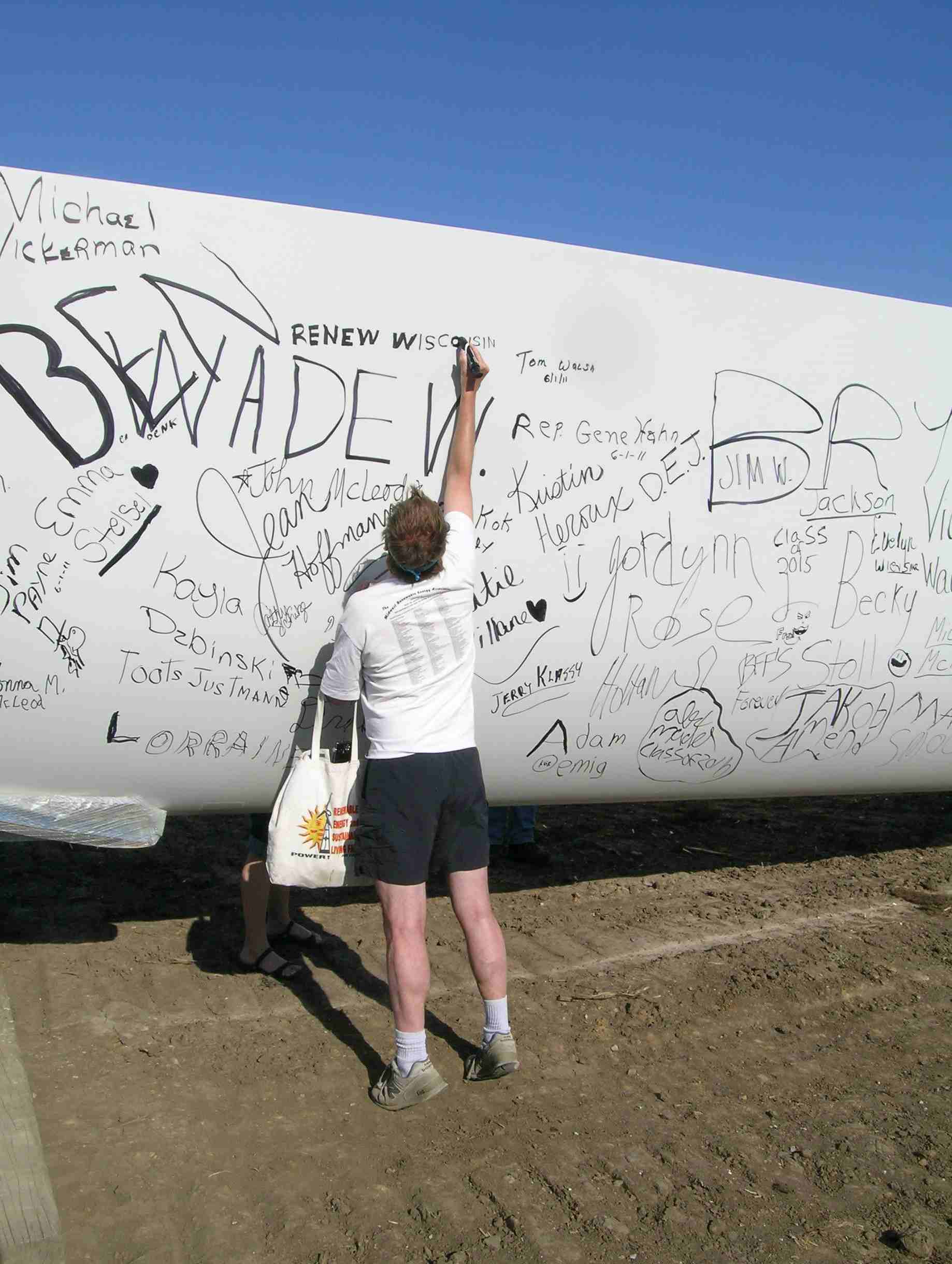
TOWN OF SCOTT - Along with names, dates and shout-outs to favorite sports teams, the writing on the turbine blade included a warning: "Watch out."

Mark Barden wrote it, in permanent black marker.

The warning, he said, is aimed at any birds that might fly near the blade once it's turning, 400 feet in the air.

Wednesday's open house at the Glacier Hills Wind Park was Barden's first up-close look at the components of the 90 electricity-generating wind turbines that have begun to rise in the skyline in northeast Columbia County.

But it won't be his last look. Barden said three of the towers will be on his land in the town of Scott, just outside of Cambria.

He said he doesn't share the health and safety concerns about the wind towers that many of their opponents cited in seeking to block the construction of Glacier Hills - things such as constant low-level noise and shadow flicker.

"I'm more worried," he said, "about the red lights at night," he said. "When I look in the sky and try to find constellations, all I'll see is the red beacons (on the towers).

"But," Barden added, "we'll deal with that."

Barden was one of several hundred people who attended the open house, which included indoor easel and tabletop displays, and a tour - on foot or by school bus - of one of the four towers that, as of Wednesday, had two of its four segments erected.

Mike Strader, site manager for the We Energies project, said that, barring wind or other inclement weather, plans call for adding the top two segments to at least one of the towers today, with the hub, cell and three blades of the turbine to follow soon.

More photos on RENEW's Facebook page.

Thursday, May 26, 2011

Energy groups oppose bill to undermine Wisconsin's renewable energy commitment

From statements issued by three groups in opposition to Assembly Bill 146:

"Clearly, this bill is a drastic step in the wrong direction for our state. The Wisconsin Energy Business Association therefore opposes this attack on renewable energy in our state." - Wisconsin Energy Business Association. Full statement.

We strongly recommend that this bill not be approved as it solves no known problem in Wisconsin and seeks only to roll-back policies on renewable energy that have served the state well and are otherwise benefitting Wisconsin residents with cleaner air and lower prices for electricity. - Wind on the Wires. Full statement.

Fresh attack on Wisconsin voters’ desire for a renewable energy standard would kill wind projects and sap state’s economy, say wind energy advocates - American Wind Energy Association. Full statement.

Wednesday, May 11, 2011

Milwaukee solar manufacturer lands huge contract and added financing

From an article by Tom Content in the Milwaukee Journal Sentinel:

Helios Solar Works was awarded an additional $150,000 in financing for the purchase of robotic manufacturing equipment at its factory in the Menomonee River Valley.

Helios, which began production in February, was initially awarded a $500,000 by the Milwaukee Economic Development Corp., a business lender affiliated with the city of Milwaukee, but the size of the company’s investment in robotic equipment has increased. MEDC’s loan and finance committee awarded more funding on Tuesday. . . .

Steve Ostrenga, Helios chief executive, said the increase resulted from higher costs for robotic equipment used in the production of solar panels that it says are more efficient than competitors’ panels. . . .

Ostrenga has just won its largest order to yet for solar panels, Ostrenga said.

“We just landed a 1-megawatt order,” he said. “That’s huge, so we’re making that right now.”

The 1 megawatt order is part of a 5-megawatt solar project that is expected to be one of the largest single solar projects in Europe, he said.

Thursday, May 5, 2011

Another step backward on jobs and energy independence

From an editorial in the Milwaukee Journal Sentinel:

Pay attention to this number.

$4.39.

That was the price of regular unleaded gasoline at a station on Milwaukee's south side on Tuesday. It's a number that's likely to rise. It's also a number that Gov. Scott Walker and the Legislature are so far ignoring as they put together a budget that does much for roads and highway funding but threatens to gut public transit systems across the state.

On Tuesday, the Legislature's budget committee took another step backward on transit when it voted to repeal authority for four regional transit authorities created in 2009. One of those would have been responsible for a commuter rail line connecting Kenosha, Racine and Milwaukee.

Keep in mind that Walker's budget also cuts aid to transit by 10%, moves transit aid from the state transportation fund to the general revenue budget and bars municipalities from raising taxes to make up for the loss in aid. By repealing the RTAs, the budget also removes another tool - a cooperative one - that local communities could have used to help them deal with the loss of funding.

The committee also voted to eliminate a $100 million bonding program for capital transit projects in southeastern Wisconsin and to eliminate all state funding - $5 million over two years - for bike and pedestrian paths.

Why does this matter? Several reasons, but let's talk about just two.

First, there are people without cars who rely on transit to get them to jobs, appointments, shopping and friends. Some can't afford a vehicle; others prefer not to have one. Having a car should not be a requirement for living in urban areas such as Milwaukee, Madison, Racine and Waukesha. Giving people options that include transit as well as good roads make those areas more attractive for economic development.

Second, as gas prices continue to rise, many commuters are looking for alternatives to driving to their jobs. In a recent informal and unscientific poll by the Editorial Board, a slight majority of respondents said that a $4-per-gallon price for gasoline would be enough to make them change their driving habits.

Twitter Delicious Facebook Digg Stumbleupon Favorites More

 
Design by Free WordPress Themes | Bloggerized by Lasantha - Premium Blogger Themes | Top WordPress Themes